This is an excellent argument for change in education. It highlights both the outmoded form of current education and the need for educational reform that pays more than lip service to differentiation, individualised learning and using technology to improve the depth of student learning. The animation is cute but the content of the talk is vital.
It is this intelligent questioning of pedagogy that must be the driving force behind educational reform. As always the technology is simply a tool that enables change. Technology without solid pedagogical reform is mere window dressing.
Showing posts with label Technology. Show all posts
Showing posts with label Technology. Show all posts
Tuesday, November 9, 2010


Sunday, November 7, 2010
Andrew Churches
Most of the information on the Bloom's Digital Taxonomy post was gleamed from Andrew Churches Wiki. For a detailed analysis of Bloom's Digital Taxonomy check out his wikispaces site. Not only has he given explanations of Blooms Elements of Learning but he provides examples of the types of tools that teachers could use whilst implementing digital technologies.
Andrew's Educational Philosophy:
The world is not as simple as saying teachers are digital immigrants and students digital natives. We have to change how we teach, how we assess, what we teach, when we teach it, where we are teaching it, who we are teaching and with what. Its a tall order, but these are exciting times. This is not just about the integration of technology into the classroom, though this is certainly a critical area. It is about shifting the entire paradigm of education.

Andrew's Educational Philosophy:
The world is not as simple as saying teachers are digital immigrants and students digital natives. We have to change how we teach, how we assess, what we teach, when we teach it, where we are teaching it, who we are teaching and with what. Its a tall order, but these are exciting times. This is not just about the integration of technology into the classroom, though this is certainly a critical area. It is about shifting the entire paradigm of education.
Bloom's Digital Taxonomy
Bloom's Taxonomy has been a cornerstone on which we have based our teaching practice. For many teachers it was the starting place when writing a task or even a unit of work. Unfortunately his Taxonomy does not take into account computers in schools or 1-to-1 laptops programs.
In the 1990's, a former student of Bloom, Lorin Anderson and David Krathwohl, revised Bloom's Taxonomy and published Bloom's Revised Taxonomy in 2001. The major difference is the use of verbs rather than nouns for each of the categories and a rearrangement of the sequence within the taxonomy.

This update to Bloom's Revised Taxonomy attempts to account for the new learning models emerging as technology advances and becomes more prevalent. Bloom's Revised Taxonomy describes many traditional classroom practices, behaviours and actions, but it also adds new processes and actions associated with Web 2.0 technologies. Bloom's Digital Taxonomy isn't about the tools or technologies rather it is about using these to facilitate learning.
Bloom's Digital Taxonomy is the new go to document when designing activities. This list is the the Web 2.0 bible of activities. Use this as a starting point to get into Web 2 tools or use as a reminder of the other tools that your students could also be using.
Remember - the individual tools are irrelevant it is the processes and then the deeper learning that occurs with the use of some of these tools.

In the 1990's, a former student of Bloom, Lorin Anderson and David Krathwohl, revised Bloom's Taxonomy and published Bloom's Revised Taxonomy in 2001. The major difference is the use of verbs rather than nouns for each of the categories and a rearrangement of the sequence within the taxonomy.

This update to Bloom's Revised Taxonomy attempts to account for the new learning models emerging as technology advances and becomes more prevalent. Bloom's Revised Taxonomy describes many traditional classroom practices, behaviours and actions, but it also adds new processes and actions associated with Web 2.0 technologies. Bloom's Digital Taxonomy isn't about the tools or technologies rather it is about using these to facilitate learning.
Bloom's Digital Taxonomy is the new go to document when designing activities. This list is the the Web 2.0 bible of activities. Use this as a starting point to get into Web 2 tools or use as a reminder of the other tools that your students could also be using.
Remember - the individual tools are irrelevant it is the processes and then the deeper learning that occurs with the use of some of these tools.
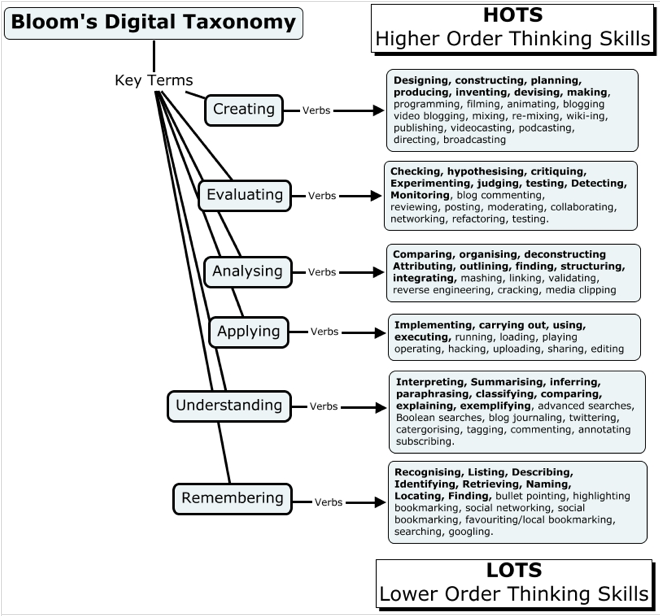
From Andrew Churches Website - http://edorigami.wikispaces.com/.
Subscribe to:
Posts (Atom)